
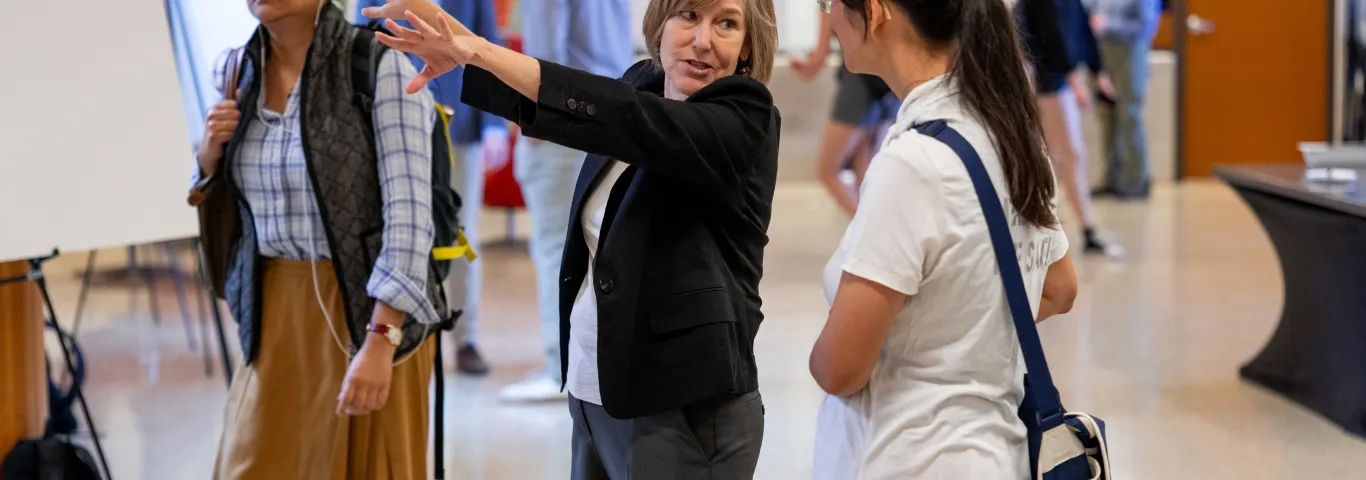
“I definitely want to keep doing research. Coming into the project with very little experience but succeeding means that I can expand my horizons past what I have already done and know to things I am curious about.” -First-year participant in the SP25 ARC pilot
The Office of Undergraduate Research (OUR) is excited to continue the Advancing Research Culture (ARC) program for its second semester in Spring 2026 following last year’s pilot. ARC is designed to help faculty integrate first-year undergraduate students into their research projects, addressing the need for earlier on-ramps to research engagement for students of all backgrounds and disciplines. Faculty submit projects and the OUR matches them to first-year students new to research who apply to ARC. Interested faculty can find detailed information below.
Faculty project proposals for Spring 2026 will be accepted via the proposal form through Monday, October 6, 2025. For questions about project suitability, program logistics, or other issues, please contact the OUR at undergradresearch@wustl.edu or drop by upcoming ARC office hours with OUR Faculty Director, Lori Markson:
- Friday, September 12, from 10 – 11:30 am
- Friday, September 26, from 1 – 2:30 pm
- Attend either session in person (Somers Family Hall 416F) or via Zoom
Overview
ARC supports faculty in integrating first-year undergraduate students into their research projects. The program addresses the need for early research opportunities during the academic year, particularly in disciplines where pathways are less defined. Participating faculty receive $500 from the OUR to support student training, materials and project expenses.
ARC is open to undergraduate students from all backgrounds and disciplines, offering students without prior research experience access to meaningful research training that might otherwise be unavailable. By leveraging federal work-study to provide financial support to eligible students, the program removes barriers to participation, ensuring that all students have the opportunity to engage in research. Early exposure to the research process helps students build essential skills and confidence, preparing them for future collaboration with faculty or independent projects. This engagement fosters a culture of inquiry and positions research as a fundamental part of a WashU education.
Getting involved in the ARC program allows you to impact the accessibility of undergraduate research at WashU. The program provides support and a streamlined process for recruiting and matching motivated students to your projects, enabling you to explore new directions that might have otherwise been challenging. Engaging students before they declare a major can spark their interest in your field and potentially further work in your department, as the following ARC student quotations demonstrate:
- “I had originally intended to major in Business and Computer Science, but I found that I wasn’t enjoying my business classes. At the same time, I realized how much more engaged I felt in my psychology courses and research experience. Thanks to research I realized where my true interests lie.”
- “For my academic interests, this experience has made me realize that I would enjoy studying WGSS further in some capacity… I found out the humanities are a nice breath of fresh air for me on top of my anticipated Chemistry major.”
- “This experience has sparked my curiosity to become more involved somehow in the WashU Dance/Performing Arts department. All the people I have met and interacted with through this experience have been wonderful, whether it be the students or my mentor, and I would love to build a deeper bond with this community.”
Through your mentorship, you cultivate a culture of inquiry that benefits students and our campus community.
The OUR will provide Arts & Sciences faculty members with $500 per project to support student research expenses (materials, training, etc.). Additionally, the OUR will facilitate a peer cohort among the students, offering them extra mentorship, support and accountability to enhance their experience and complement the faculty's guidance.
Program Expectations
ARC students are expected to
- actively and reliably engage in their assigned research tasks for 3-10 hours per week, as agreed upon with their faculty mentor.
- ask questions, communicate effectively, meet deadlines and demonstrate a commitment to learning.
- participate in monthly reflection exercises and meetings through the OUR to help them critically engage with their work and stay on track.
To recognize their contributions and support their academic development, students will earn academic credit through a directed study course. If your department doesn’t already offer a relevant class (e.g., Anthro 290: Introduction to Directed Research), the Arts & Sciences registrar can create one. Each faculty mentor will have a section in their department’s course to document their efforts, and the OUR will manage this process, including coordinating department chair approvals. This approach benefits both students and departments by creating additional pathways for undergraduates to engage in research.
Additionally, the OUR will also cover the employer portion of wages for federal work-study eligible students, broadening access to research experiences for all undergraduates regardless of their financial situation.
Faculty mentors invest their time and expertise to nurture a student’s development as a researcher. In partnership with the OUR, they also provide an accountability structure to ensure student fulfillment of curricular and employment expectations. You are expected to provide guidance, support and supervision to the student, as follows:
- Review and sign a mentor-mentee agreement at the start of the program to set clear expectations and define the scope of the student's role.
- Provide the training and resources needed for your mentee to succeed, including regular meetings and discussions of their research progress.
- Educate and include the student on the conceptual work of the project.
- Assign a grade (P/NP) in the directed studies course and, if applicable, approve student employee hours for federal work-study eligible students.
ARC is designed to engage first-year students new to research, so projects requiring highly specialized skills or significant independent work might not be the best fit. Faculty are encouraged to consider how undergraduates can contribute to ongoing research efforts while gaining exposure to the research process. ARC pilot projects included the following student responsibilities (see these example projects):
- Conduct literature reviews and create annotated bibliographies or short summaries of key works
- Engage in archival research: reading, extracting, transcribing, translating and/or coding information from sources for input into a database
- Utilize text mining, keyword analysis and related applications (e.g. Python, OCR) to examine large bodies of texts
- Note-taking during seminars or other documentation
- Gather policy documents at the federal, state and local level
- Community outreach, e.g., to facilitate participation, to report on research findings
- Support the preparation of project outputs, such as presentations, grants and publications through proofreading, formatting or reviewing for clarity
- Collect, manage, code, and/or analyze interview or behavioral data
- Develop 3D modeling skills to mockup historical designs of technologies
- Use MatLab to produce interactive visuals (no coding experience necessary)
- Perform and analyze nested sampling simulations (no coding experience necessary)
- Participate in team meetings
It's perfectly acceptable for students to start with more routine tasks if they are also introduced to the broader research and ideation process. We're happy to discuss how your current research can involve undergraduates in a way that benefits both your work and the student's growth.
Program Logistics
Submitting an ARC project proposal is straightforward. You’ll complete a form that comprises the prompts below. Submissions should use language accessible to first-year students.
- Project title and description: Provide a brief title (sentence) and overview of the research project (paragraph).
- Student tasks and responsibilities: What will the student do as part of the project?
- Learning goal: What can the student expect to gain from engaging in this project?
- Ideal student qualities: List up to three attributes that would indicate that a student is good fit for the project and has the potential to grow through participating.
- Time commitment: Indicate the estimated hours per week the student would engage in the project.
- Logistical considerations (optional): Note any constraints on when or where the student would need to work on the project (e.g., specific days or hours, the need for in-person work, etc.)
Ready to submit? https://undergradresearch.wustl.edu/advancing-research-culture-arc-project-proposal-form
On the application, first-year students will identify projects that align with their interests and goals. The OUR will select a slate of strong candidates for the program, giving particular consideration to students who have had limited access to research opportunities and show potential for growth through participation in ARC.
The OUR will then match the selected students to projects where their articulated interests and strengths align with project learning goals and ideal student qualities. Importantly, these first-year students may not yet have taken courses in your area or know their major; ARC is an opportunity to catalyze their interest in your department or program, rather than solidifying it. Faculty help open doors to research for students who may be new to the field but are eager and ready to engage.
Once matches are made, the OUR will forward the application(s) of the student(s) matched to your project for your review. We greatly appreciate faculty who step forward to create ARC opportunities. While matches are not guaranteed, our goal is to connect each faculty member with at least one student, and last year every project received a match. Faculty have the flexibility to accept or decline any student match and can choose to accept up to two students per project.
A key goal of ARC is to facilitate early entry into undergraduate research, especially among students with no prior research experience. If a student is already working on your research, they will not be selected for the program, and they cannot be supported through ARC.
If a student has approached you about joining your research in spring 2026, you can encourage them to apply for the ARC program. Please note, however, that the student may not ultimately be selected for the ARC program nor matched to your project.
If they are not already, existing mentees should be registered for academic credit for research (see this page for additional information). If your department or program does not have a 1000- or 2000-level directed study course appropriate for early research experiences, the OUR can provide support creating such a course in collaboration with your department and the Arts & Sciences registrar.
Faculty project proposals: Through October 6, 2025
Student ARC applications: November 5 at 11:59 PM
ARC matches to mentors: November 21
Mentors review and approve matches: December 10
If any questions remain unanswered, please do not hesitate to contact the OUR at undergradresearch@wustl.edu.